
Blog
What History Can Teach Us About Organizational Performance
As a teenager, history was probably one of the subjects I appreciated the least. There was too much reading, too many dates, and too many events that seemed disconnected from real life. I struggled to understand why I needed to remember things that had happened hundreds of years before.
It is interesting how perspective changes.
Years later, during my professional life, I began to see history differently. I stopped looking at it as a collection of dates and events and started seeing it as a study of human behaviour.
The same patterns that influenced the rise and fall of societies also appear inside organizations. The way people adapt to their environment, the way ideas spread, the way competition drives improvement, and the way invisible forces influence behaviour are not only historical concepts. They are organizational realities. However, there is also a danger in making connections between history and business. We often take a complex idea and reduce it to a simple statement because it sounds logical.
For years, organizations have described culture as an iceberg …. suggesting that what we see above the surface is only a small part of what drives behaviour. The analogy is useful, but it can also oversimplify reality. Culture is not just something hidden beneath the surface; it is something people create, reinforce, and change every day through their actions.The problem is that this oversimplifies the argument.
A better way to look at history is not as a direct formula for business success, but as a lens that helps us ask better questions.
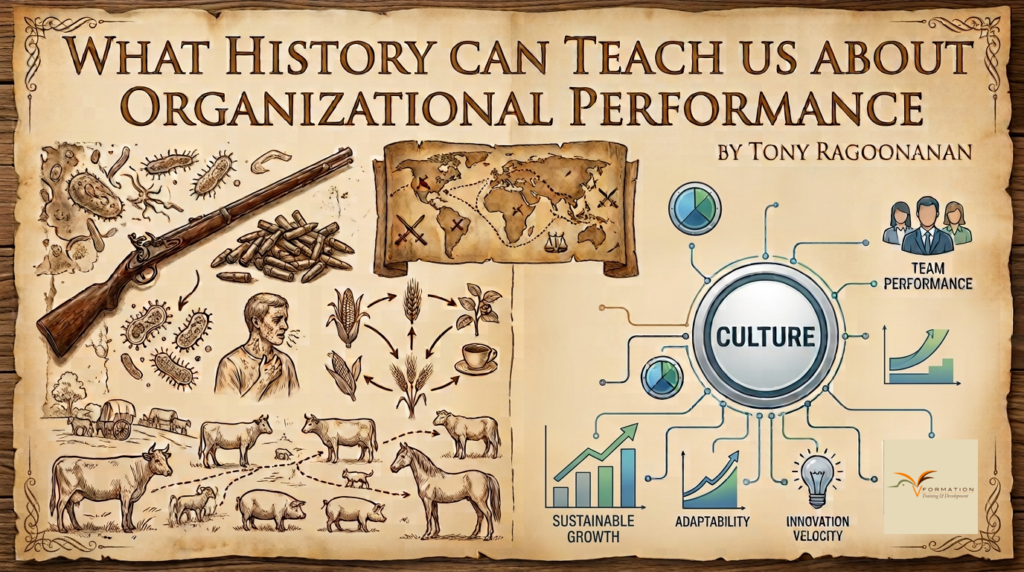
One of the books that influenced this way of thinking for me was Jared Diamond’s “Guns, Germs, and Steel”. While his ideas focus on the development of civilizations, they also provide interesting parallels for understanding organizations, performance, and competitive advantage.
Geography Creates Conditions for Success
One of Diamond’s arguments is that geography influenced the opportunities available to different societies.
 Eurasia had several advantages. It was a large connected landmass with many plants and animals that could be domesticated. Perhaps one of the most significant advantages was its east-west orientation.
This allowed ideas, technologies, agricultural practices, and innovations to spread more easily across similar climates and environments.
China benefited from this. Its geography allowed knowledge and innovation to move across a vast region, contributing to early advances in agriculture, technology, government systems, and economic development. But the deeper lesson is not that geography determines success. The lesson is that environments create conditions.
The same principle applies inside organizations.
Employees do not perform independently of the environment around them. Their behaviour is shaped by the systems they experience every day: leadership style, decision-making processes, communication patterns, reward systems, and opportunities for development.
A company cannot simply tell employees to “perform better” while maintaining an environment that prevents performance. Culture is not created through slogans, posters, or motivational speeches.
Culture emerges from repeated experiences. The way leaders behave, the way decisions are made, and the way people are treated eventually become the culture of the organization. This is why performance management is much bigger than setting goals and conducting annual reviews. It is about creating the conditions where people can consistently perform at their best.
The Danger of Relying Only on Past Advantages
China’s historical development also provides another important lesson. The same conditions that allowed rapid growth did not guarantee permanent dominance. History shows that even highly advanced societies can become vulnerable when they fail to adapt. China’s size, sophistication, and achievements did not make it immune from external threats. This is an important lesson for organizations. Success creates confidence, but sometimes it also creates complacency.
A company can have a strong brand, talented employees, established processes, and years of success behind it. However, if it stops learning and adapting, yesterday’s advantage can become tomorrow’s weakness.
Performance management should not only focus on measuring what people have achieved. It should also focus on developing what the organization will need in the future. The question leaders should constantly ask is:
“Are we building capability, or are we simply benefiting from what we already have?”
Competition Forces Improvement
Eventually Europe developed through a different set of circumstances. Unlike China’s large connected geography and centralized imperial governance, Europe was divided into many competing states. This competition created pressure to improve. Countries had to innovate, develop new technologies, strengthen their systems, and find better ways of organizing resources because they were constantly challenged by neighbouring powers. Competition became a driver of evolution.
Organizations experience something similar. Competition forces companies to improve products, refine processes, and develop new capabilities. However, competition alone does not create excellence. The organizations that succeed are usually the ones that combine pressure with development. They do not simply demand more from people. They invest in making people better.
This is where performance management becomes critical.
Clear expectations, meaningful feedback, coaching, accountability, and development opportunities create the environment where people can grow. High performance is rarely the result of having better people alone. It is usually the result of building a better system around those people.
The Advantage That Cannot Be Copied
One of the biggest mistakes organizations make is believing they can copy successful companies. They copy their technology. They copy their processes. They copy their strategies. But they often fail to copy the one thing that created the advantage in the first place.
The people.
A competitor can purchase similar equipment. They can implement similar systems. They can even hire employees with similar qualifications. But they cannot easily replicate the behaviours, relationships, trust, and shared beliefs that have developed over years. This is where people become the true value proposition of an organization. The competitive advantage is not simply having talented employees. The advantage comes from how effectively the organization develops and aligns that talent. A company with average systems and exceptional people will eventually struggle. A company with exceptional systems and disengaged people will also struggle. The greatest organizations are those where the human capability and the organizational environment reinforce each other.
The Invisible Forces That Shape Performance
One of the most fascinating lessons from Guns, Germs, and Steel is the role that invisible forces can play in determining the direction of societies.
When Europeans arrived in the Americas, the outcome was influenced by more than weapons, technology, or military strategy. One of the most powerful forces was something that could not be seen: disease.
For thousands of years, different societies developed under different environmental conditions. In Eurasia, close interaction with domesticated animals contributed to the development and spread of diseases that populations gradually adapted to over generations. In contrast, many Indigenous populations in the Americas had a different historical experience with disease exposure. When new diseases were introduced, the impact was devastating, with illnesses such as smallpox causing enormous population losses.
The important lesson is not that one group was more intelligent, capable, or superior than another. The difference was not about human potential; it was about circumstances, environments, and accumulated experiences over time. This reveals a powerful principle: systems are often shaped by forces that are difficult to see.
Organizations have their own invisible forces.
-Trust.
-Fear.
-Psychological safety.
-Unspoken assumptions.
-Informal behaviours.
-The stories employees tell themselves about leadership.
These forces rarely appear on a performance dashboard, but they influence performance every day.
A company may have a clear strategy, but if employees do not trust leadership, execution will suffer. A company may have talented people, but if fear prevents them from speaking up, innovation will disappear. A company may invest heavily in training, but if the environment does not support new behaviours, little will change.
Just as invisible forces influenced the development of societies, invisible forces influence the performance of organizations.
This is why performance management cannot be reduced to goals, metrics, and evaluations alone. Performance is always a reflection of the environment people operate within.
The question leaders must ask is not only:
“What results are we achieving?”
but also:
“What conditions are creating those results?”
Turning History’s Lessons Into Organizational Action
The lessons from history are not that organizations need to copy what successful societies did. The lesson is that outcomes are created by systems. The environment people operate in influences their behaviour. The behaviours that are reinforced become the culture. The culture ultimately influences performance. This is why improving organizational performance requires more than setting targets and measuring results.
Leaders must ask:
–Are our systems helping people succeed, or are they creating barriers to performance?
-Are our leaders reinforcing the behaviours required to achieve our strategy?
-Are employees clear about what success looks like and how their role contributes to it?
-Are we developing capability, or are we simply evaluating outcomes after the fact?
These questions sit at the heart of effective performance management. A high-performing organization does not happen by accident. It is built through alignment between strategy, leadership behaviour, employee capability, and the systems that support performance. The greatest competitive advantage an organization has is not something that can simply be purchased or copied. It is the collective capability of its people. And that capability must be intentionally developed.
How I Help Organizations Improve Performance
Through my work as an Emotional Intelligence and Performance Strategist, I help organizations identify the behaviours, systems, and leadership practices that influence performance.
This includes helping organizations:
-Align employee behaviour with strategic goals
-Strengthen performance management systems
-Develop leaders who create accountability and engagement
-Improve communication and trust within teams
-Build the capabilities required for sustainable performance
If your organization is experiencing challenges with inconsistent performance, leadership alignment, employee engagement, or translating strategy into action, I would welcome the opportunity to explore how performance can become a stronger driver of results.
Because the question is not only:
“How do we get better performance from our people?”
The better question is:
“How do we create the conditions where better performance becomes the natural outcome?”
 Tony Ragoonanan is the Founder of V-Formation Training & Development. As a Certified Emotional Intelligence/Performance Strategist, he helps individuals, teams and organizations to align skills, behaviours and outcomes. Outside of this, it’s all about family, football, and fitness!!
868-681-3492 | tonyr0909@gmail.com

Related posts



to Tony’s fortnightly blog/article and immediately
receive a short but effective bit of information.
- Quick Links
- Home page
- About Us
- Testimonials
- OurCourses
- Blog
- Contact us
- Get In Touch
- Home
- About us
- Testimonials
- Our Courses
- Blog
- Contact
Leave a reply