
Blog
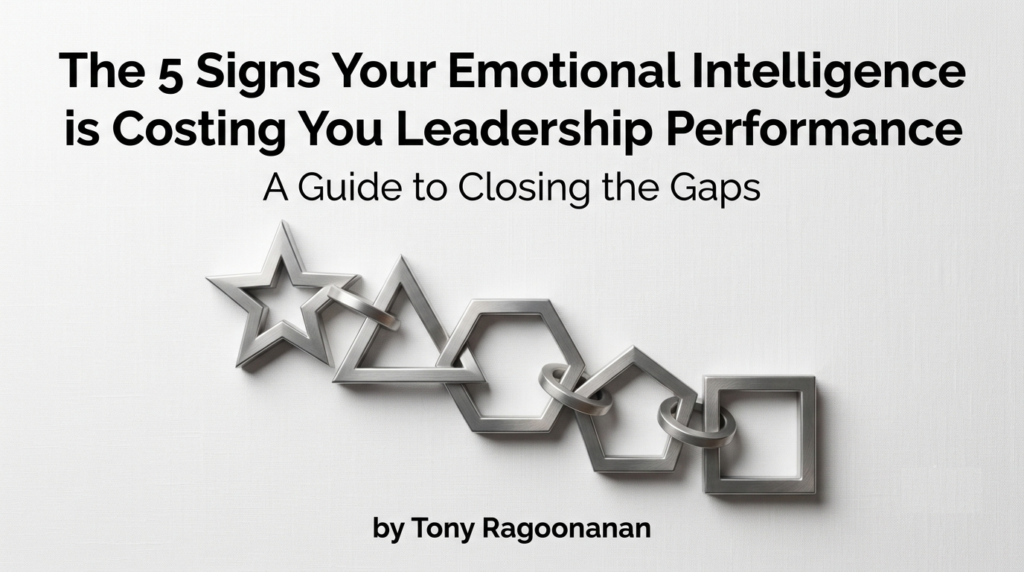
The 5 Signs Your Emotional Intelligence is Costing You Leadership Performance
There is a version of leadership that looks perfectly competent on the surface.
The results are delivered. The meetings are run. The targets are hit. But something underneath is not quite right. The team is quiet in ways that feel uncomfortable. Good people keep leaving. Conversations that should be straightforward somehow become tense. And the leader cannot always explain why.
In most of these cases, the issue is not strategy. It is not skill. It is not even effort.
It is emotional intelligence. Or more accurately, the quiet cost of not having enough of it.
Emotional intelligence is not a soft skill. It is a performance skill. Research by TalentSmart found that EI accounts for 58 percent of performance across all types of jobs, and that 90 percent of top performers are high in emotional intelligence. When it is underdeveloped, it shows up not as a dramatic failure but as a slow leak. Results that could be better. Relationships that could be stronger. A culture that could be healthier.
Here are five signs that your emotional intelligence may be costing you more than you realize.
1. You React Before You Think
You are in a meeting and someone challenges your idea. Before you have fully processed what they said, you have already responded. Maybe it came out sharper than you intended. Maybe you dismissed the point without genuinely considering it. Maybe you won the argument but lost the room.
This is not a communication problem. It is a self-management problem.
Leaders who react before they think are operating from what neuroscientists call an amygdala hijack. The emotional brain fires before the rational brain has a chance to engage. In a single interaction, this can damage trust, shut down contribution and signal to your team that it is not safe to challenge you.
The cost is not just one bad moment. It is the conversations your team stops having with you because they have learned what happens when they do.
High EI leaders develop a pause. Not a hesitation born of weakness but a deliberate space between stimulus and response. That space is where leadership actually happens.
2. You Think Empathy is Weakness
There is a belief that has quietly destroyed more leadership potential than almost anything else. It goes like this: if I show too much understanding, people will take advantage of me. If I get close to my team’s emotions, I will lose my edge. Empathy is for therapists, not executives.
This belief is not just wrong. It is expensive.
Empathy is the ability to understand and share the feelings of another person. It does not mean agreeing with them. It does not mean abandoning accountability. It means understanding where someone is before you decide what they need from you.
Leaders who lack empathy make decisions about people without understanding those people. They deliver feedback that misses the mark because they have not taken the time to understand how it will land. They implement change without considering how their team will experience it emotionally. And then they are surprised when people disengage, resist or leave.
Empathy is not about being liked. It is about being effective. When your team believes you understand them, they are more likely to trust you, follow you and tell you the truth. And leaders who get the truth from their teams make better decisions than those who don’t.
3. You Cannot Name What You Are Feeling
This one is more common than most leaders want to admit.
Ask the average leader how they are feeling in a high-pressure moment and they will say one of three things: fine, stressed or frustrated. That is not emotional vocabulary. That is emotional shorthand. And it costs more than it seems.
Research by neuroscientist Lisa Feldman Barrett shows that the ability to precisely identify and name your emotions, what she calls emotional granularity, is directly linked to your ability to regulate them. In simple terms: if you cannot name it, you cannot manage it.
A leader who does not know what they are actually feeling cannot communicate it clearly. They cannot explain to their team why they responded a certain way. They cannot identify the emotional pattern that keeps showing up in their leadership. And they cannot do the inner work needed to change it.
Self-awareness is the foundation of emotional intelligence. It is the practice of understanding your inner world well enough to prevent it from unconsciously running your outer behaviour.
The question is not whether your emotions are influencing your leadership. They always are. The question is whether you are aware enough to influence them back.
4. Your Team Tells You What You Want to Hear
This sign is subtle and dangerous in equal measure.
If every update you receive is positive, every idea you float gets enthusiastic agreement and nobody ever pushes back in your meetings, this is not a sign that everything is going well. It is a sign that people have stopped feeling safe enough to tell you the truth.
Psychological safety, the belief that you can speak up without fear of humiliation or punishment, does not appear by accident. It is built or eroded by the emotional signals a leader sends every single day. When a leader reacts badly to bad news, people stop delivering it. When a leader dismisses challenges, people stop raising them. When a leader’s mood dictates the tone of every room they walk into, people learn to manage that mood rather than do their best work.
The result is a team that is performing for the leader rather than for the mission. And a leader who is making decisions based on filtered, sanitized information.
High EI leaders actively create the conditions for honest conversation. They manage their own reactions visibly and consistently. They reward truth-telling even when the truth is uncomfortable. They understand that their emotional climate is the climate their team lives in.
If your team only tells you what you want to hear, the question worth sitting with is: what have I taught them to expect when they don’t?
5. You Struggle to Perform Under Pressure
Every leader faces pressure. The ones who sustain high performance over time are not the ones who face less of it. They are the ones who have developed the emotional capacity to navigate it without it eroding their effectiveness.
Stress tolerance and emotional regulation are core competencies of emotional intelligence. Without them, pressure does not just feel harder. It actively degrades performance. Decision-making narrows. Communication becomes less precise. Relationships suffer. And the leader who needs to be at their best in the hardest moments is often at their worst.
There is also a secondary effect that leaders rarely consider. Your team reads your stress. They are always watching how you carry uncertainty, setback and difficulty. When you cannot manage your own emotional state under pressure, you are not just underperforming. You are undermining the confidence of everyone around you.
This does not mean pretending everything is fine when it is not. Authenticity matters. But there is a significant difference between a leader who acknowledges difficulty and remains grounded, and one who absorbs it and destabilizes. The former builds trust. The latter erodes it.
What You Can Do About It
Recognizing your blind spots is only half the battle. To build true emotional intelligence, you need deliberate, daily practices. Here is a practical roadmap to close the gaps in the five areas we covered.
The Golden Rule of EQ Development: You cannot change your automatic emotional reactions overnight, but you can entirely change how long you let them control your behavior.
Take the Next Step
Building emotional intelligence is a lifelong practice, but you don’t have to guess where to start.
To help you map out your specific growth areas, i’ve put together a complimentary assessment designed to pinpoint your exact leadership blind spots.
Feel free to take the FREE Emotional Intelligence Assessment to identify areas of development.
 Tony Ragoonanan is the Founder of V-Formation Training & Development. As a Certified Emotional Intelligence/Performance Strategist, he helps individuals, teams and organizations to align skills, behaviours and outcomes. Outside of this, it’s all about family, football, and fitness!!
868-681-3492 | tonyr0909@gmail.com

Related posts



to Tony’s fortnightly blog/article and immediately
receive a short but effective bit of information.
- Quick Links
- Home page
- About Us
- Testimonials
- OurCourses
- Blog
- Contact us
- Get In Touch
- Home
- About us
- Testimonials
- Our Courses
- Blog
- Contact
Leave a reply